

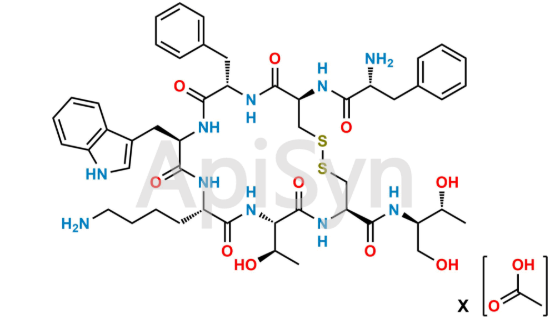
Octreotide Acetate (CAS 79517-01-4), is a synthetic somatostatin analogue octapeptide from the cyclic disulfide-bridged somatostatin mimetic chemical class. It has a sequence of D-Phe-Cys-Phe-D-Trp-Lys-Thr-Cys-Thr-ol, with a disulfide bridge between Cys2 and Cys7 and a threoninol (Thr-ol) residue at the C-terminal end. FDA-approved for acromegaly, carcinoid syndrome, VIPomas, and to stop problems after pancreatic surgery. Octreotide has a plasma half-life of about two hours, while native somatostatin has a half-life of about two minutes. It works like somatostatin by stopping the release of GH, glucagon, insulin, and GI peptides. Important process-related impurities are linear (non-cyclized) octreotide, mixed disulfide dimers, D-Trp→L-Trp epimer, des-D-Phe1 deletion peptide, and Thr-ol C-terminal truncation products.
ApiSyn offers Octreotide Acetate as a pharmaceutical reference standard for validating HPLC methods and controlling the quality of somatostatin analogues.
| Chemical Name | (4R,7S,10S,13R,16S,19R)-13-((1H-Indol-3-yl)methyl)-19-((R)-2-amino-3-phenylpropanamido)-10-(4-aminobutyl)-16-benzyl-N-((2R,3R)-1,3-dihydroxybutan-2-yl)-7-((R)-1-hydroxyethyl)-6,9,12,15,18-pentaoxo-1,2-dithia-5,8,11,14,17-pentaazacycloicosane-4-carboxamide acetate |
| Molecular Formula | C49H66N10O10S2 : X(C2H4O2) |
| Molecular Weight | 1019.2 : X(60.1) |
| CAS Number | 79517-01-4 |